




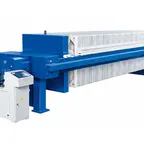

A filter press is a machine that separates solids from liquid by filtering slurry under pressure. The liquid leaves as clear filtrate, while the solids are held back as a firm block called the cake. It is used in wastewater treatment, mining, petrochemicals, food and many other industries to reduce waste volume and recover water. See our filter press models for example sizes and capacities.
Parts of a filter press
- Frame: two heads (fixed and moving) joined by side beams that carry the plates.
- Filter plates: recessed plates arranged in a row. The space between two plates is where the cake forms.
- Filter cloth: covers the plate surface and does the actual filtering.
- Pressing system: manual or hydraulic, closing the plates tightly so they do not leak while slurry is pumped in.
- Feed pump: pushes the slurry into the filter press, for example a pneumatic diaphragm pump or a screw pump.
How a filter press works, step by step
- Close and press the plates. The hydraulic or manual system closes all plates to form sealed chambers.
- Fill with slurry. The pump pushes slurry into each chamber through the feed hole.
- Filtration. The liquid passes through the filter cloth, runs along the grooves in the plate and leaves as filtrate. The solids stay on the cloth and start to form a cake.
- Cake full. As the cake thickens, the filtrate flow slows and the pressure rises. When the chambers are full, the pump stops.
- Squeeze and wash (optional). With membrane plates, the membranes are inflated with water or air to squeeze the cake drier. The cake can also be washed or blown with air.
- Open and discharge. The plates are opened one by one and the cake drops out. The cloth is cleaned if needed, and the cycle starts again.
One cycle can take from tens of minutes to several hours, depending on the slurry and the target cake dryness.
Types of filter plates
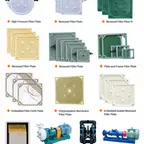
- Recessed plates: the most common type; both faces are recessed so a chamber forms between two plates.
- Membrane plates: have a membrane that inflates to squeeze the cake, giving a drier cake and a shorter cycle.
- Plate and frame: flat plates alternating with frames; suited to clarifying filtration and cakes that need washing.
Replacement plates and cloth are on the filter press cloth and filter plates page.
Where filter presses are used
- Municipal wastewater: sludge dewatering at city and industrial estate treatment plants.
- Mining and metallurgy: concentrates, tailings and ore slurry.
- Petrochemicals: chemical sludge and catalysts.
- Food and pharmaceuticals: separating solids from process liquids.
- Building materials and sand washing: slurry from washing sand and stone.
- Lithium batteries and photovoltaics: battery and solar panel materials.
- River dredging: sediment and dredged mud.
- Piling and tunnelling: drilling mud and bentonite.
- Pulp, paper and textiles: pulp and dyeing wastewater.
Advantages and limits
Advantages: the cake is drier than with many other dewatering methods, the design is simple and robust, capacity is easy to increase by adding plates, and operating costs are relatively low.
Limits: the process runs in cycles (batch), not continuously, and manual models need an operator to open the plates. Automatic hydraulic models with an automatic plate shifter reduce this work.
Common problems and fixes
- Cloudy filtrate: torn cloth, the wrong cloth, or cloth not yet coated with cake at the start of the cycle. Check the cloth and, if needed, return the first filtrate to the slurry tank.
- Wet or incomplete cake: filtration time too short, pump pressure too low, or the slurry needs conditioning with flocculant first.
- Leaks between plates: not enough closing force, dirty or damaged sealing faces, or cloth folded at the edge.
- Cake sticking to the cloth: the cloth is blinded or the wrong type. Wash the cloth or change to a smoother weave.
Routine maintenance
- Wash the filter cloth regularly with pressurised water, and replace it once it has hardened or torn.
- Clean leftover cake from the plate sealing faces before closing the plates.
- Check the hydraulic oil level and leaks, and the condition of the hoses and feed pump.
- Check the plates for cracks or warping, especially after abnormal pressure.
Common questions
What is the difference between a filter press and a belt press?
A belt press works continuously with two belts that squeeze the sludge, while a filter press works in cycles at higher pressure, so the cake is usually drier.
How long does filter press cloth last?
It depends heavily on the slurry and the number of cycles per day, from a few months to over a year. Replace it when the filtrate turns cloudy or filtration slows down.
Can a filter press handle metal finishing wastewater?
Yes. Sludge from vibratory finishing and grinding can be separated with a filter press so the water can be treated further or reused.
How to choose a filter press
Start from the slurry data: daily volume, solids content, particle size, temperature and chemistry. From these, the cake volume per cycle and the number of cycles per day are worked out, which set the plate size, the number of plates and the filter area. Then decide the target cake dryness (standard or membrane plates) and the level of automation you want.
Send us your slurry data and our team will help work out the right filter press size.