



Sandblasting is the process of cleaning and roughening a surface by blasting abrasive grains at high speed with compressed air. It removes rust, old paint, and scale from welding or heat treatment, and prepares the surface so paint and coatings bond strongly. The terms sandblast and sandblasting are used for the same process. For routine work in a factory, it is done with a sandblasting machine or inside an enclosed blast room.
How sandblasting works
Every sandblasting machine works on the same principle: air from a compressor carries abrasive through a hose to a nozzle, and the abrasive leaves at high speed and strikes the surface. Each grain removes a little rust, paint or scale and leaves a tiny dent in the metal. These dents form the surface profile, which lets paint or coatings "grip" firmly.
The result depends on four things: the type and size of the abrasive, the air pressure, the nozzle size, and the blasting distance and angle. Experienced operators usually blast from about 30–60 cm at an angle of 60–90 degrees to the surface.
Types of sandblasting machines
Pressure blasting machines
The abrasive is held in a pressurised pot and pushed by air into the hose and nozzle. It has the strongest blast, so it suits heavy rust, old paint and large surfaces such as ships, tanks, bridges and steel structures. Pressure pots come in portable versions for site work and fixed versions for blast rooms.
Suction blasting machines
Airflow inside the gun creates a vacuum that draws abrasive from a container. They are simple and economical, and suit light to medium work and small parts, usually inside a blast cabinet.
Wet blasting
The abrasive is mixed with water before blasting. There is much less dust, so it suits areas that must stay clean or are close to other work. The finish is also smoother. The downside is that steel must be protected quickly so it does not rust again.
Blast rooms
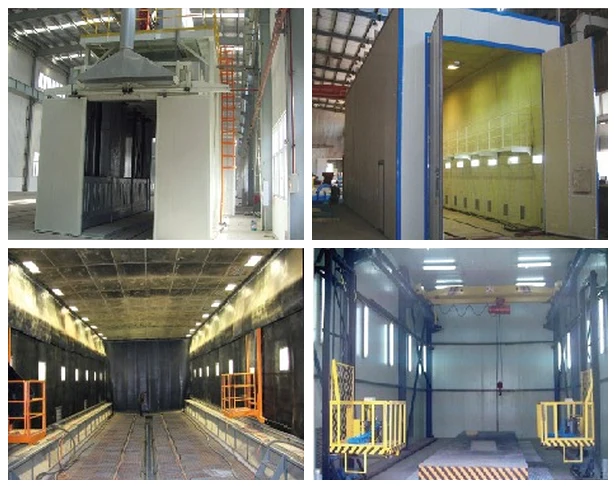
For routine work in a factory, sandblasting is best done in an enclosed room. A dust collector captures the dust, the abrasive is collected from the floor, screened and reused, and work is not affected by the weather. A blast room is built to fit the largest part, from machine components to rail wagons and steel structures.
Open blasting or a blast room?
Open blasting is used for objects that cannot be moved: installed tanks, ships in dry dock, bridge structures or pipelines on site. The equipment is simple, but the abrasive is usually used once and the dust has to be controlled.
A blast room suits parts that come to the factory regularly. The investment is higher, but abrasive costs drop because metal abrasives such as steel grit can be reused hundreds of times, and the workplace is safer.
Types of sandblasting abrasive
River sand or ordinary silica sand should no longer be used: silica dust is harmful to the lungs and the grains break down quickly. The common choices today are:
- Garnet sand: a hard, sharp natural mineral with low dust, the main choice for open blasting.
- Steel grit: angular steel grains that give a deep profile; ideal in blast rooms with a recycling system.
- Steel shot: round steel grains for cleaning and shot peening, used mostly in shot blasting machines.
- Glass beads: round glass beads for a smooth, even finish without removing much material.
- Stainless steel shot and cut wire shot: for aluminium, copper and stainless steel, so no rust stains are left.
Specifications and how to choose are on the sandblasting sand and metal abrasives page.
Equipment and safety
A complete sandblasting set consists of a compressor with enough capacity, a dryer or dehumidifier so the abrasive does not clump, a blast pot, hoses and couplings, an abrasive valve and a nozzle. Air demand rises steeply with nozzle size: a 6 mm nozzle at about 7 bar needs roughly 2.5 m³ of air per minute, while a 9.5 mm nozzle needs about 5–6 m³ per minute.
Operators must wear a blasting helmet with a clean air supply, a protective suit of leather or heavy canvas, gloves and hearing protection. The work area needs ventilation or a dust collector, and hoses must be checked regularly, because a worn hose can burst under pressure.
When to choose shot blasting
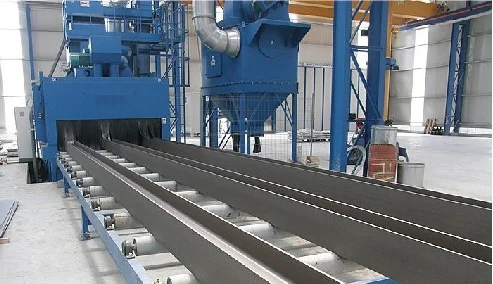
Sandblasting is flexible but slow for high-volume production. When parts arrive continuously and have fairly regular shapes, such as castings, plates, sections or thousands of small parts, a shot blasting machine is usually much faster and cheaper, because the abrasive is thrown by a blast wheel without a large compressor. The full comparison is in the article shot blasting vs sandblasting.
Sandblasting steps before painting
- Preparation. Remove oil and grease first, because sandblasting does not remove oil and actually spreads it. Mask anything that must not be blasted, such as threads, bearings and machined surfaces.
- Check the air. Make sure the compressed air is dry and oil-free. Moist air makes the abrasive clump and the surface rust again quickly.
- Blasting. Blast evenly from top to bottom at a consistent distance and angle, overlapping each pass slightly.
- Inspect the result. Check the cleanliness and roughness of the surface. For steel that will be painted, the usual cleanliness grade is Sa 2½ to ISO 8501-1: a near-white surface with only very faint staining.
- Remove dust. Blow off the remaining dust and abrasive with dry air or vacuum it.
- Paint promptly. Freshly blasted steel rusts again easily, especially in humid air. Apply the primer within a few hours of blasting.
Common mistakes
- Compressor too small: pressure drops while blasting, work is slow and the result uneven.
- Worn nozzles not replaced: an enlarged nozzle bore wastes air and abrasive.
- Abrasive too fine or too coarse: too fine gives a shallow profile so paint bonds poorly; too coarse gives a profile that is too deep and wastes paint.
- Wet or dirty abrasive: used abrasive mixed with dust and rust lowers the quality and can contaminate the surface.
Common questions
What is the difference between sandblast and sandblasting?
There is none. Both refer to the same process; "sandblast" is often used as a verb or for the machine, "sandblasting" for the process.
Can sandblasting be used for deburring?
Yes, to remove fine burrs and tidy edges. For deburring large quantities of small parts, a vibratory or shot blasting machine is usually more efficient.
Does sandblasting damage thin metal?
It can warp thin sheet if the pressure is too high or the abrasive too coarse. Use lower pressure, finer abrasive and a longer blasting distance.
Summary
- Sandblasting blows abrasive with compressed air to clean and roughen surfaces.
- Pressure machines for heavy work, suction machines for light work, wet blasting for low-dust areas.
- A blast room saves abrasive and makes routine work safer.
- Use the right abrasive and avoid silica sand.
Need a sandblasting machine or blast room? Tell us the size of your parts and the job, and our team will help you choose.